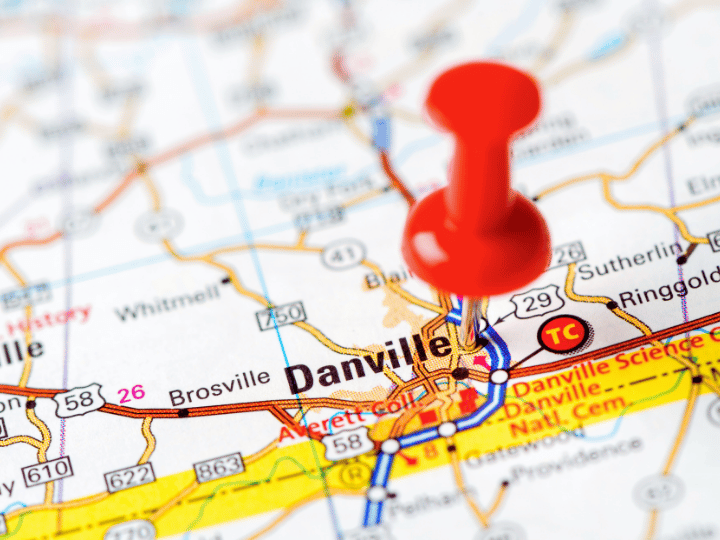
Failure to Appear and the North Carolina Line Near Danville
Danville sits directly on the Virginia and North Carolina border, and that geography adds a wrinkle to failure to appear cases that inland Virginia cities do not face. A defendant who misses a Danville court date and slips across the state line creates a recovery problem tangled in the laws of two states. Anyone dealing with Danville VA bail bonds near that border benefits from understanding how the state line changes a failure to appear case and why cross-state licensing matters here in a way it does not elsewhere.
The border is close and porous in daily life. Residents of Danville routinely work, shop, and have family across the line in North Carolina towns like Reidsville, Eden, and beyond. That everyday movement is harmless until a defendant with a pending Danville case uses it to avoid a court date. Once a person under a Virginia bond crosses into North Carolina, the clean return that Virginia law contemplates becomes a coordination problem across two separate legal systems.
Why the State Line Complicates Recovery
A Virginia capias is an order from a Virginia court, and its direct force runs within Virginia. When a defendant is in North Carolina, returning that person to a Danville courtroom involves the cooperation of North Carolina authorities and, in many cases, formal processes that take time. A bondsman licensed only in Virginia can find that recovery stalls at the state line, because acting to locate and surrender a defendant in another state is not something a single-state license authorizes.
Time is the problem this creates. The 150-day window under Virginia Code Section 19.2-143 does not pause because a defendant crossed a border. The clock keeps running while the cross-state coordination unfolds, which means delay at the line can eat into the window that protects the bond and the co-signer's collateral. For Danville VA bail bonds written near the border, the risk of a defendant crossing into North Carolina is a real factor in how the recovery has to be handled.
The Value of Dual Licensing
This is where a bondsman licensed in both states changes the picture. Apex Bail Bonds owner Fred Shanks IV holds a Virginia Department of Criminal Justice Services bondsman license along with North Carolina licensing, which lets the same bondsman operate on both sides of the Danville border without handing the case off to a separate North Carolina agency. A defendant who crosses the line does not fall into a gap between two single-state operations, because one licensed bondsman can coordinate the recovery across the corridor directly.
The practical value shows up in speed. A referral from a Virginia-only bondsman to a North Carolina agency adds a handoff, a new relationship, and lost days, all while the 150-day clock runs. A single bondsman authorized in both states skips that handoff and keeps the recovery moving. For families holding Danville VA bail bonds on a defendant with ties across the line, that continuity can be the difference between a return inside the window and a bond that hardens into forfeiture during a delay.
The Clock Ignores the Border
The 150-day forfeiture window under Virginia Code Section 19.2-143 keeps running even when a defendant crosses into North Carolina, so delay at the state line can eat into the window that protects the bond and the co-signer's collateral.
A Virginia Capias Runs in Virginia
A capias is an order from a Virginia court with direct force within Virginia, so returning a defendant from North Carolina requires cross-state coordination that a single-state bondsman may not be able to handle directly.
One License Set Covers the Corridor
Apex Bail Bonds owner Fred Shanks IV holds both Virginia DCJS license 99-529833 and North Carolina license 18812863, letting one bondsman work both sides of the Danville border without a referral to a separate agency.
The Danville area functions as part of a cross-border corridor that runs from Southside Virginia into the North Carolina Piedmont. Families, jobs, and daily life span the line, and criminal cases sometimes do too. A defendant might face charges in both states, or have a Virginia charge and a strong pull toward family in North Carolina. A bondsman who works this corridor understands that the state line is a legal boundary but not a practical barrier to the people living around it, and that recovery has to account for that reality rather than pretend the border stops movement.
This corridor view also helps before a bond is written. A bondsman evaluating Danville VA bail bonds on a defendant with heavy North Carolina ties can weigh that factor honestly, structure the bond and any collateral accordingly, and prepare the co-signer for the added risk. Understanding the border is part of understanding the case, and a bondsman who works both sides brings that understanding to the table from the start.
What Families Near the Border Should Know
For a family holding a bond on a defendant near the North Carolina line, the border adds one clear lesson: the risk of a defendant crossing over is real, and it makes cross-state capability a genuine advantage rather than a marketing line. A co-signer whose collateral is on the line has a direct stake in whether the bondsman can actually reach a defendant who fled across the border. Asking that question before signing, and choosing a bondsman who can operate in both states, is a concrete protection specific to the Danville market.
The border does not change the core rules. A missed date still triggers a capias, still adds a charge under Virginia Code Section 19.2-128, and still starts the 150-day forfeiture clock under Virginia Code Section 19.2-143. What the border changes is the recovery, and a bondsman who can work both sides of it keeps the same tools available even when the defendant leaves the state. For families around Danville, that cross-state reach is one of the more practical distinctions among the bondsmen serving the area.
One Bondsman, Both States
The advantage of dual licensing near Danville comes down to keeping the recovery whole. A case that would fracture at the state line for a single-state operation stays in one set of hands when the bondsman is licensed in both Virginia and North Carolina. That continuity protects the 150-day window, the co-signer's collateral, and the defendant's chance at a return that resolves the missed date rather than deepening it. For Danville VA bail bonds written along a border that people cross every day, that reach is worth understanding before it is needed.
Questions Worth Asking Before Signing
The border gives families around Danville a specific set of questions to ask before choosing who writes a bond. The first is whether the bondsman is licensed in both Virginia and North Carolina. A defendant with family, work, or history across the line has an easy path into another state, and a co-signer's collateral rests on whether the bondsman can reach a defendant who crosses over. A bondsman who holds only a Virginia license may have to refer a cross-border recovery, adding a handoff and lost days.
Other questions follow from the same concern. Does the bondsman charge the 10 percent Virginia floor or the 15 percent ceiling. Are payment plans structured as interest-free installments, as Virginia law requires. Does the bondsman post bonds around the clock, since arrests and returns rarely keep business hours. Can the bondsman handle the size of bond the case may require. For Danville VA bail bonds written near the border, the cross-state question sits at the top of that list, because it is the one a single-state operation cannot answer well.
How the Corridor Works in Practice
The Danville area functions as one connected region that happens to straddle a state line. People live on one side and work on the other, and families span both. A defendant released in Danville might spend weekends in North Carolina without any intent to flee, which means a routine part of life can look like a forfeiture risk on paper. A bondsman who works the corridor understands the difference between ordinary cross-border life and an actual attempt to avoid court, and can structure Danville VA bail bonds with that reality in mind rather than treating every border crossing as a red flag.
That practical understanding also speeds a recovery when a defendant does try to avoid a court date across the line. A bondsman already operating in both states knows the local geography, the routes, and the way cases move on each side, which shortens the time to locate and return a defendant before the 150-day window closes. For families holding Danville VA bail bonds along the border, that corridor knowledge is as valuable as the dual license itself.
Beyond the Two-State Line
Most Danville cases stay within Virginia or reach only into nearby North Carolina, but a few involve other layers, and a bondsman who works the area recognizes them. A defendant might face a charge in a Virginia court and a separate matter in a North Carolina county, requiring coordination of two cases at once. Others involve travel that carries a defendant well beyond the immediate border, which lengthens a recovery and makes the 150-day window under Virginia Code Section 19.2-143 tighter. Knowing when a case reaches past the simple two-state situation is part of handling Danville VA bail bonds honestly.
The core lesson holds regardless of how far a case reaches. A missed date starts the same clock, and a return to court stops it. What changes with distance is the effort required to bring the defendant back, and that effort favors a bondsman with the reach and the licensing to act rather than refer. For families arranging Danville VA bail bonds on a defendant whose life spans more than one jurisdiction, choosing a bondsman built for that reality is a practical safeguard, not a luxury, because the recovery capability only matters when it is actually needed.
The Pittsylvania County Piece
The area around Danville is more than a two-state region; it is a multi-county one, and Pittsylvania County wraps around the city on the Virginia side. A defendant might live in the county near Chatham, be booked into a county facility, and answer to the county's own court and magistrate rather than Danville's. The failure to appear rules, the capias, the charge under Virginia Code Section 19.2-128, and the 150-day forfeiture window hold the same across the county and the city. A bondsman handling Danville VA bail bonds across both keeps the response consistent whether a case sits in the city or the surrounding county, so a family is not left guessing which set of rules applies to their situation.
The border near Danville is a fact of daily life, and it shapes how a failure to appear case has to be handled. A family that chooses a bondsman able to work both Virginia and North Carolina builds in a safeguard specific to this market, one that keeps a recovery whole even when a defendant crosses the line. For Danville VA bail bonds written along that border, cross-state reach is the practical distinction worth weighing before it is needed.
Apex Bail Bonds serves the Danville border area from a Danville office at 509 Loyal Street, posting bonds across Danville City and Pittsylvania County at any hour. Owner Fred Shanks IV holds a Virginia Department of Criminal Justice Services bondsman license, number 99-529833, and North Carolina licensing, number 18812863, that allows direct coordination across the state line rather than a referral to a separate agency. Apex charges the 10 percent Virginia floor and structures payments as interest-free installments, since Virginia bars a bondsman from lending money at interest for bail. A family with a defendant near the North Carolina line can reach Apex Bail Bonds of Danville at (434) 548-2739 at any hour for cross-state coverage most single-state bondsmen cannot match.
Worsham Street overlook, Main & Ridge St. intersection, Masonic building (River City Towers), Martin Luther King Jr. Memorial Bridge, municipal building from Union Street, repurposed Dan River Fabrics "Home" sign.(Clockwise from the top)
The city was a center of tobacco production and was an area of Confederate activity during the American Civil War,[4] due to its strategic location on the Richmond and Danville Railroad. In April 1865, Danville briefly served as the third and final capital of the Confederacy before its surrender later that year.
Danville has maintained a black majority population since the Reconstruction era. During this time, the city was represented politically by black members of the Readjuster Party. However, this changed following the Danville Massacre of 1883, after which Democrats regained control both locally and statewide.[5][6] Decades later, during the civil rights era, Danville again became a flashpoint for racial violence and resistance to desegregation efforts.
Numerous Native American tribes had lived in this part of the Piedmont region since prehistoric times. During the colonial period, the area was inhabited by Siouan language-speaking tribes.
In 1728, English colonist William Byrd headed an expedition sent to determine the true boundary between Virginia and North Carolina. Late that summer, the party camped upstream from what is now Danville. Byrd was so taken with the beauty of the land, that he prophesied a future settlement in the vicinity, where people would live "with much comfort and gaiety of Heart." He named the river along which they camped as the "Dan", for Byrd felt he had wandered "From Dan to Beersheba."[8]
After the American Revolutionary War, the first settlement developed in 1792 downstream from Byrd's campsite, at a spot along the river shallow enough to allow fording. It was named "Wynne's Falls", after the first settler. The village developed from the meetings of pioneering Revolutionary War veterans, who gathered annually here to fish and talk over old times.
In 1793, the state General Assembly authorized construction of a tobacco warehouse at Wynne's Falls. This marks the start of the town as "The World's Best Tobacco Market", Virginia's largest market for brightleaf tobacco. The village was renamed "Danville" by an act of November 23, 1793.
Danville was home to tobacco entrepreneur William T. Sutherlin. The city was sometimes called the "last capitol of the Confederacy"Dan's Hill estate in western DanvilleWreck of the Old 97, 1903The abandoned Dan River Mills on the Dan River
A charter for the town was drawn up on February 17, 1830, but by the time of its issue, the population had exceeded the pre-arranged boundaries. This necessitated a new charter, which was issued in 1833. In that year, James Lanier was elected the first mayor, assisted by a council of "twelve fit and able men."
By the mid-19th century, William T. Sutherlin, a planter and entrepreneur, was the first to apply water power to run a tobacco press. He became a major industrialist in the region.
In the mid to late 1800s, several railroads reached Danville, including the Richmond and Danville Railroad (completed 1856), and the Atlantic and Danville Railway (completed 1890). These enabled the export of Danville's manufacturing and agricultural products. The major growth in industry came in the late 19th century, after the war. The Southern Railway, successor to the Richmond and Danville, built a grand passenger station in Danville in 1899, which is still in use by Amtrak and is a satellite facility of the Virginia Museum.
At the outbreak of the Civil War, Danville had a population of approximately 5,000 people. During the war years, the town was transformed into a strategic center of Confederate activity. William Sutherlin was named quartermaster of its depot. The rail center was critical for supplying Confederate forces, and a hospital station was established for Confederate wounded. A network of batteries, breastworks, redoubts and rifle pits defended the town.[4]
A prison camp was set up, with the conversion of six tobacco warehouses, including one owned by Sutherlin, for use as prisons. At one time they held more than 5,000 captured Union soldiers. Malnutrition and dysentery, plus a smallpox epidemic in 1864, caused the death of 1,314 of these prisoners. Their remains have been interred in the Danville National Cemetery.
In 1865, Danville hosted the Confederate government. Confederate President Jefferson Davis stayed at Sutherlin's mansion from April 3 to 10, 1865, and the house became known as the "Last Capitol of the Confederacy."[9] Here he wrote and issued his last Presidential Proclamation. The final Confederate Cabinet meeting was held at the Benedict House (since destroyed) in Danville. Davis and members of his cabinet left the city when they learned of Lee's surrender at Appomattox, and moved to Greensboro, North Carolina, making their way south. On the day they left, Governor William Smith arrived from Lynchburg to establish his headquarters here.
In 1882, the biracial Readjuster Party had gained control of the city council, causing resentment and even alarm among some white residents; even though the council was still dominated by white members, the city had a majority African-American population. The Readjuster Party had been in power at the state level since 1879. Violence broke out on November 3, 1883, a few days before the election, when a racially motivated street fight turned to shooting after a large crowd gathered; five men were killed, four of them black. A local Danville commission found African Americans at fault for the violence on November 3, but a US Senate investigation decided that white residents were to blame. No prosecution resulted from either inquiry.[10][11]
In the late 19th and continuing into the early 20th centuries, tobacco processing was a major source of wealth for business owners in the city, in addition to the textile mills. Wealthy planters and owners built fine houses, some of which have been preserved.
Given the falls on the river, the area was prime for industrial development based on water power. On July 22, 1882, six of Danville's residents (Thomas Benton Fitzgerald, Dr. H.W. Cole, Benjamin F. Jefferson and three brothers: Robert A., John H., and James E. Schoolfield) founded the Riverside Cotton Mills, making use of cotton produced throughout the South. Both the Riverside Cotton Mills and Danville itself grew tremendously during Fitzgerald's leadership of the company as President. In its day it was known nationally as Dan River Inc., the largest single-unit textile mill in the world.
As the industrial town grew rapidly, it attracted many single workers, and associated gambling, drinking, and prostitution establishments. By the early 20th century, the city passed laws against gambling, but it continued in small, private places.[9] On September 9, 1882, Danville Mayor John H. Johnston shot and killed John E. Hatcher, his chief of police. Hatcher had demanded an apology for a statement Johnston had made regarding unaccounted fine money. Johnston was charged with murder, but he was acquitted at trial. The Southern "culture of honor" was still strong and jurors apparently believed the killing was justified.[12]
The Southern Railway constructed a railroad line to the city in the late 19th century and had facilities here, which contributed to the growing economy. In 1899, the company completed a grand passenger station, designed by its noted architect Frank Pierce Milburn. For many years, passenger traffic was strong on the railroad; it also operated freight trains.
A serious train wreck occurred in Danville on September 27, 1903. "Old 97", the Southern Railway's crack express mail train, was running behind schedule. Its engineer "gave her full throttle", but the speed of the train caused it to jump the tracks while on a high trestle crossing the valley of the Dan River. The engine and five cars plunged into the ravine below, killing nine and injuring seven. The locomotive and its engineer, Joseph A. ("Steve") Broadey, were memorialized in song. A historic marker at the train crash site is located on U.S. 58 between Locust Lane and North Main Street. A mural of the Wreck of the Old 97 has been painted on a downtown Danville building to commemorate the incident.
Afterward Democrats forced African Americans out of office and suppressed their voting rights. In November 1883 Democrats regained control of the state legislature by a large majority, and pushed out the Readjuster Party.
White Democratic legislators interpreted the Danville events as more reason to push blacks out of politics. In 1902, the state legislature passed a new constitution that raised barriers to voter registration, effectively disenfranchising most blacks and many poor whites, who had been part of the Readjuster Party. They excluded them from the political system, causing them to be underrepresented and their segregated facilities to be underfinanced.[13]
On July 15, 1904, the Danville police successfully broke up a lynching party by firing warning shots above a crowd. About 75 white men had gathered at the jail to take Roy Seals, an African American man arrested as a suspect in the murder of a white railroad worker. The police saved Seals and the city quickly indicted some of the lynch mob; several men were convicted, fined and served 30 days in jail. The killer was found to have been another white man, who was prosecuted.[9]
On March 2, 1911, Danville police chief R. E. Morris, who had been elected to three two-year terms and was running for a fourth term, was arrested as an escaped convicted murderer. He admitted that he was really Edgar Stribling of Harris County, Georgia. He had been on the run for thirteen years.[14]
On October 13, 1917, Walter Clark was lynched. He was an African American man who had fatally shot a policeman while resisting arrest for the killing of his common-law wife. Clark held off the police for two hours, but a mob gathered and set his house on fire. He was shot multiple times and killed as he left the house. His was the last lynching in Danville.[9]
Heightened activism in the civil rights movement in Virginia occurred in Danville during the summer of 1963. Since the early 20th century, most blacks had been excluded from voting by the state constitution, which had created barriers to voter registration. White Democrats had imposed legal segregation after regaining control of the state legislature following the Reconstruction era, and Jim Crow laws maintained white supremacy. On May 31, representatives of the black community organized as the Danville Christian Progressive Association (DCPA), demanding an end to segregation and job discrimination in the city. They declared a boycott of white merchants who refused to hire blacks and marched to City Hall in protest of conditions.
Most of the marchers were high school students. Police and city workers, armed with clubs, beat the young protesters and sprayed them with fire hoses. Around forty protesters needed medical attention, but the marches and other protests continued for several weeks.[15] Reverend Martin Luther King Jr., leader of the Southern Christian Leadership Conference (SCLC), came to Danville and spoke at High Street Baptist Church about the police brutality. He said it was the worst he had seen in the South. The date of one protest on June 10, 1963, later came to be referred to as "Bloody Monday."[16]
The Student Nonviolent Coordinating Committee (SNCC) sent organizers to Danville to support the local movement. They helped lead protests, including demonstrations at the Howard Johnson Hotel and restaurant on Lee Highway. The hotel was known for discriminating locally against blacks as customers and excluding them as workers. A special grand jury indicted 13 DCPA, SCLC, and SNCC activists for violating the "John Brown" law. This law, passed in 1830 after a slave uprising, made it a serious felony to "...incite the colored population to acts of violence or war against the white population." It became known as the "John Brown" law in 1860 because it was used to convict and hang abolitionist John Brown after his raid on Harpers Ferry in 1859.[15]
The Riverwalk Trail near the Dan Daniel Park along the Dan River
By the end of August, more than 600 protesters had been arrested in Danville on charges of inciting to violence, contempt, trespassing, disorderly conduct, assault, parading without a permit, and resisting arrest. Because of the large number of arrests on these charges, often the jails were overcrowded, and protesters were housed in detention facilities in other nearby jurisdictions. The demonstrations failed to achieve desegregation in Danville at that time. Town facilities remained segregated until after passage of the Civil Rights Act of 1964. African American residents were mostly unable to register and vote until after the federal government enforced their constitutional rights under the Voting Rights Act of 1965.[15]
Since the late 20th century, the textile industry has moved to offshore, cheaper labor markets. The Dan River mill has closed and many of its buildings have been torn down, with the bricks sold for other uses. "The White Mill" of the Dan Mill complex, considered historically and architecturally significant, is being renovated in the early 21st century as an apartment complex.[17]
In the late 20th century, the restructuring of the tobacco, textile, and railroad industries all had an adverse effect, resulting in the loss of many jobs in Danville. The decline in passenger traffic caused the Danville railroad station to fall into disuse. It was listed on the National Register of Historic Places in 1995, and has been renovated by a combination of public and private funding. Today part of the station is devoted to the first satellite facility of the Science Museum of Virginia.
The station renovations were completed in 1996. This project spurred investment in other warehouse properties, "which have been redeveloped into offices, commercial spaces, apartments, lofts, and restaurants. The approximately $4 million of federal grant money initiated the redevelopment and leveraged additional funds from public and private sources."[18]
Related spaces were developed for a park with amphitheater, a community meeting and recreation facility, and the Danville Farmer's Market. The city used ISTEA funds in association with the Virginia Department of Transportation, and partnered also with Amtrak, Pepsi-Cola, and other private sources.
The city and region continue to work to develop new bases for the economy. At the beginning of the century, in the 2000s, the economic losses made it challenging to preserve the city's many architecturally and historically significant properties dating from its more prosperous years.[19]
In 2007, Preservation Virginia President William B. Kerkam, III, and its Executive Director Elizabeth S. Kostelny announced at a press conference held in Danville at Main Street Methodist Church that the entire city of Danville had been named as one of the Most Endangered Historic Sites in Virginia.[19] This designation highlighted the importance of preserving Danville's architectural and historical heritage and drew attention to the challenges of maintaining these properties amid economic struggles.
Danville has been actively working to redevelop its River District as a hub for community life and economic activity. This effort includes revitalizing historic buildings, fostering local businesses, and promoting heritage tourism to attract visitors and stimulate economic growth.[20]
In 2020, the city approved a referendum to open a casino at the site of the old mill. On December 17, 2024, Caesars Virginia opened to the public. It is expected to generate significant revenue and create jobs for the community.[needs update][21][22][23][24]
According to the U.S. Census Bureau, the city has a total area of 43.9 square miles (113.7 km2), of which 43.1 square miles (111.6 km2) is land and 1.0 square mile (2.6 km2) (2.3%) is water.[29]
Danville has a humid subtropical climate (KöppenCfa). Winter nights usually average below freezing, with air frosts being abundant during that season. During summer, it is influenced by the strong sun and convective air masses, providing both hot temperatures and frequent thunderstorms.[30]
Danville city, Virginia – Racial and ethnic composition Note: the US Census treats Hispanic/Latino as an ethnic category. This table excludes Latinos from the racial categories and assigns them to a separate category. Hispanics/Latinos may be of any race.
As of the 2020 census, Danville had a population of 42,590. The median age was 43.0 years. 20.7% of residents were under the age of 18 and 22.4% of residents were 65 years of age or older. For every 100 females there were 84.7 males, and for every 100 females age 18 and over there were 81.0 males age 18 and over.[48][49]
96.8% of residents lived in urban areas, while 3.2% lived in rural areas.[50]
There were 19,015 households in Danville, of which 25.4% had children under the age of 18 living in them. Of all households, 28.1% were married-couple households, 22.0% were households with a male householder and no spouse or partner present, and 43.9% were households with a female householder and no spouse or partner present. About 39.3% of all households were made up of individuals and 17.3% had someone living alone who was 65 years of age or older.[48]
There were 22,259 housing units, of which 14.6% were vacant. The homeowner vacancy rate was 3.4% and the rental vacancy rate was 10.7%.[48]
As of the census[51] of 2010, Danville had a population of 43,055. The racial makeup of the city was White Non-Hispanic 46.7%, African American 48.3%, Hispanic 2.9%, Asian 0.9%, Native American or Alaska Native 0.2%, and two or more races 1.3%.
25.4% of the population never married, 46.6% were married, 5.4% were separated. 11.6% were widowed and 11.0% were divorced.[52]
Swedwood, a subsidiary of IKEA, opened its first factory in the U.S. in this city, in 2008. It employed more than 300 people but closed in December 2019.[56][57]
Revitalized Craghead Street in the River District, 2019
Prior to the recession of 2008, the City of Danville and its partners began a major project focused on the revitalization of the Historic Downtown and Tobacco Warehouse districts, now coined "The River District." The project continues with a new momentum as the public sector has joined the movement. See Danville River District.[59][60][61]
Tobacco Warehouse Historic DistrictPemberton & Penn Tobacco Co. building, built 1885–1890, Tobacco Warehouse Historic District
Millionaire's Row has many homes built in the late 19th and early 20th centuries by successful tobacco planters, who gained their wealth in this commodity crop. The mansions are in an area of many street trees and often have their own well-developed landscaping.[62][63]
The entire area of Penn's Bottom, the nickname for the part of Main Street that was developed as the first suburb of Danville during the tobacco boom of the late 19th century, has been designated as a historic district. Other recognized historic districts include The Old West End, Tobacco Warehouse, Downtown Danville, Holbrook–Ross Street, and North Main.
In April 1865, Sutherlin offered his mansion to President Jefferson Davis and his cabinet as the site of the last "Capitol of the Confederacy" after the fall of Richmond. The museum and its grounds occupy a block in this district.[65] In the late 19th century, Sutherlin's surrounding plantation was subdivided and developed to create the surrounding residential neighborhood.
Old Danville Hotel that now works as a nursing facility for the elderly
From 1948 until 2004, Danville was a consistent Republican stronghold in presidential elections. However, John Kerry won the city by 37 votes in 2004, and since then it has swung heavily into the Democratic column by margins of usually over 20 percentage points.
United States presidential election results for Danville, Virginia[69][70]
Danville has a council–manager government in which a city manager is hired by council to supervise the city government and ensure that the ordinances and policies made by the city council are carried out in an effective manner.[71]
The city council consists of nine members elected from single-member districts representing residents. The city council selects the mayor and vice mayor from among its members to serve two-year terms.[71]
The city council has the power "to adopt and enforce legislative and budgetary ordinances, policies, and rules and regulations necessary to conduct the public's business and to provide for the protection of the general health, safety and welfare of the public."[71]
In 2025, City Councilman Lee Vogler was set on fire by a man who knew Vogler personally and alleged that his wife had cheated with Vogler. After the attack, Vogler was airlifted to the burn unit at UNC-Chapel Hill. The man was diagnosed with multiple conditions that led to a disassociative episode during his time at Central State Hospital, where he spent two weeks in custody after the attack. The man was convicted of aggravated malicious wounding, for which the man received a life sentence suspended to 35 years, and attempted first-degree murder, for which the man received a 10-year sentence suspended to 5 years.[72]
In conjunction with a contraction of Minor League Baseball beginning with the 2021 season, the Appalachian League was reorganized as a collegiate summer baseball league, and the Braves were replaced by the Danville Otterbots in the revamped league designed for rising college freshmen and sophomores.[74][75]
WMDV-LD, an independent television station owned by the Martinsville, VA-based Star News Corporation
Danville was once the home of WDRL-TV 24, a station that was an affiliate of the WB and United Paramount Network before changing ownership from 2007 to 2014. Today, it is known as WZBJ, a sister channel of WDBJ and is owned by Gray Television.[104]
U.S. Route 58 (Riverside Dr/River St) parallels the north bank of the Dan River traveling east–west through Danville's main commercial district while the US 58Bypass route bypasses the city's center to the south via the Danville Expressway.
U.S. Route 29 splits into a business route and a bypass at the North Carolina/Virginia border. The business route enters the heart of Danville via West Main Street and Memorial Drive and exits via Central Boulevard and Piney Forest Road; US 29 Business travels relatively north–south. The bypass (future Interstate 785) takes the eastern segment of the Danville Expressway and rejoins the business route north of the city near Chatham, Virginia.
U.S. Route 360, which connects Danville with Richmond, enters the city from the east concurrent with U.S. Route 58 (South Boston Road), continuing along U.S. Route 58 Business at the Danville Expressway interchange, and terminating at the North Main Street intersection just north of downtown.[106]
U.S. Route 311 in 2013 was expanded from North Carolina to terminate just outside Danville's western limits at U.S. Route 58.[107]
North Carolina Highway 86 becomes State Route 86 once it crosses the state line into Danville as South Main Street. It continues north to its terminus at US 29 Business/Central Boulevard.
State Route 293 was created in 1998 to mark the route of old US 29 Business, which was rerouted to the west. SR 293 enters Danville's downtown historic district as West Main Street, then Main Street, and then crosses the Dan River to meet US 29 Business as North Main Street.
State Route 51 parallels US 58 Business as Westover Drive from its western terminus at US 58 Business at the Danville's corporate limits to its eastern terminus at US 58 Business near the Dan River.
Henry Lumpkin Wilson, physician in Atlanta who served as Confederate army chief physician, later known as real estate developer and investor, local politician, drug retailer
William T. Sutherlin, planter, industrialist and politician; the first to apply steam power to tobacco hydraulics press, founder and president of Bank of Danville, hosted President Jefferson Davis and his cabinet for last week of the Confederacy government
Virgil Caine is the name and I served on the Danville train, 'till Stoneman's cavalry came and tore up the tracks again. In the winter of '65, we were hungry, just barely alive...
"It's a mighty rough road from Lynchburg to Danville" are lyrics in "Wreck of the Old 97" a song memorializing the September 27, 1903, event that became arguably the most famous train wreck in U.S. history.[140]
^"Station: Danville RGNL AP, VA". U.S. Climate Normals 2020: U.S. Monthly Climate Normals (1991–2020). National Oceanic and Atmospheric Administration. Retrieved July 2, 2021.
^"Nestle Celebrates 15 Years". discoverdanville.com Danville, Virginia Economic Development - Stories. October 23, 2003. Archived from the original on January 17, 2005. Retrieved May 27, 2026.
^Bailey, Frankie Y. (2011). History Press, Charleston SC (ed.). "Danville Past, Present and Future". Wicked Danville: liquor and lawlessness in a Southside Virginia City. p. 103. Retrieved July 15, 2024.
Calhoun, Walter T. "The Danville Riot and Its Repercussions on the Virginia Election of 1883." In Studies in the History of the South, 1875–1922, edited by Joseph F. Steelman et al., 25–51. Greenville, North Carolina: East Carolina College, 1966.
Dailey, Jane. "Deference and Violence in the Postbellum Urban South: Manners and Massacres in Danville, Virginia." Journal of Southern History 63, no. 3 (August, 1997): 553–590.
From an alternative name: This is a redirect from a title that is another name or identity such as an alter ego, a nickname, or a synonym of the target, or of a name associated with the target.
This redirect leads to the title in accordance with the naming conventions for common names to aid searches and writing. It is not necessary to replace these redirected links with a piped link.
If this redirect is an incorrect name for the target, then R from incorrect name should be used instead.
Why does cross-state licensing matter near Danville?
Danville sits on the North Carolina line, and defendants often have ties across it. A Virginia-only bondsman may have to refer a cross-border recovery to a separate North Carolina agency, adding a handoff and lost days while the 150-day clock runs. Apex Bail Bonds owner Fred Shanks IV holds licenses in both states, so one bondsman handles the whole corridor.
Can Apex Bail Bonds handle a case in both Virginia and North Carolina?
Yes. Owner Fred Shanks IV holds a Virginia DCJS bondsman license, number 99-529833, and North Carolina licensing, number 18812863. That dual authority lets the same bondsman coordinate a recovery across the Danville border without referring the case to a separate agency, which protects the 150-day window and the co-signer's collateral.